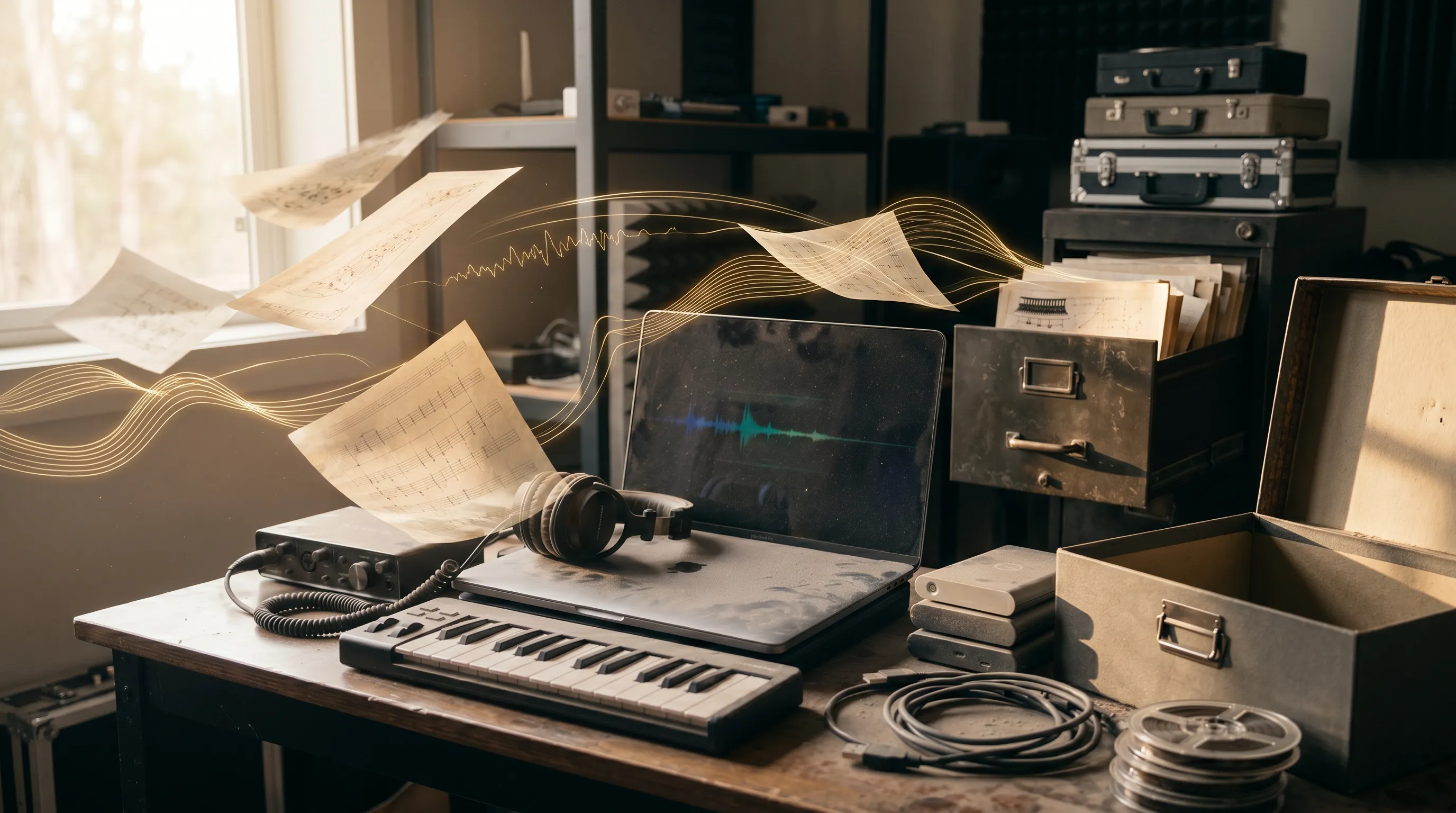
I’m at a point in my life where I’m looking back, trying to understand where I come from, where I’m standing right now and where I want to move to next. I guess this is what used to be called a “midlife crisis”. Crisis sounds too negative though. This “review and reposition” process is actually quite enjoyable. To be able to take a step back, look at your old self from a bit of a distance and better understand your trajectory in life.
I realized that there were a lot of unfinished projects in my “drawers” that were collecting dust, but I couldn’t let go of them. I wasn’t yet done with them. Not necessarily because they had ended badly, or because there was something left to repair. Ideas remained half-formed. Songs stopped after thirty seconds. Lyrics sat in folders beside unfinished arrangements, alternate versions and recordings I had not listened to in years.
They were not active projects anymore, but they were not entirely gone either.
They remained somewhere in the background: small pieces of unfinished business I was still quietly looking after. It felt as though I had been carrying these projects for years without ever allowing them to arrive, and after a while I got so used to them, I didn’t even feel their weight anymore.
When I started going through my old music again, I initially thought I was sorting an archive. In reality, I was meeting earlier versions of myself.
Some of the songs returned immediately. I remembered the rooms in which I had written them, the people around me, the emotional weather of that particular time. Others felt strangely unfamiliar. I understood the words, but no longer remembered exactly what had caused them. Occasionally, an old line would reveal something I had apparently understood years ago and then completely forgotten.
That was perhaps the most surprising part of the process.
I had expected to encounter someone I used to be. Instead, I repeatedly encountered someone who was still recognizably me.
The central questions had not changed as much as I might have assumed. The same sensitivities were there. The same need to understand what happens between people, what remains unspoken, and how we make sense of the things we cannot quite hold on to.
But my position in relation to those questions had changed.
I had learned new ways of reacting. New ways of protecting myself, sometimes useful and sometimes less so. I had acquired different tools for understanding conflict, distance, attachment, fear and loss. I could look at experiences that had once completely surrounded me from somewhere further away.
The songs had preserved the original perspective.
Returning to them allowed me to place that perspective beside the one I have now, or sometimes to melt the two together, making a process that took decades visible.
In that sense, working through the archive became less an exercise in nostalgia than a form of orientation. It helped me understand what had remained consistent, what had shifted, and which parts of myself had merely learned new methods of moving through the world.
The problem with unfinished music
I spent many years working professionally with music. I know what it traditionally takes to bring a song from an early idea to a finished production.
Even a small piece can require an enormous amount of time: arrangement, recording, editing, sound design, vocals, revisions, mixing, more revisions, and eventually the difficult decision that it is finished enough to be released.
Realistically, I would never have completed all of the music in my archive that way.
There were too many fragments, and my relationship to them was too personal and too complicated. They would have remained on old drives, occasionally rediscovered and then placed back into their folders or moved into a new home where they would remain in the attic for another cycle.
That may not have been tragic. Not everything has to be published.
But I began to feel that keeping all of it unfinished also kept something else unfinished.
I did not need every song to become a perfectly realized production. I needed to allow some of them to become complete enough to leave me.
AI as a creative partner
AI gave me a way to do that.
Using Suno allowed me to move quickly between possibilities that would previously have required days of production, or might never have been financially or practically realistic at all.
I could hear a song with a different voice. I could test an arrangement built around strings instead of guitars, move it towards electronic production, strip it back to piano, or try combinations that I would normally have dismissed because producing them properly would have taken too much time.
That speed changed the nature of experimentation.
When every direction is expensive, in either time or money, you learn to avoid certain questions. You choose the option most likely to work. You stay within the range of what you already know how to execute.
When an experiment can happen in minutes, it becomes easier to be playful. You can follow an instinct without first having to justify it.
Most of those experiments did not become the final version. But they often revealed something about the song. A rhythm exposed a tension I had not noticed. A vocal interpretation changed the apparent meaning of a line. An arrangement made a piece feel either too sentimental, too distant or unexpectedly emotionally honest.
The process was fast, but it was not automatic.
It still depended on listening, selecting, rejecting, rewriting and recognizing when something had moved closer to the emotional center of the song, or further away from it.
I do not experience the AI as the author of this music. I experience it more as a highly responsive, sometimes unpredictable production partner: one capable of generating material very quickly, but incapable of deciding why a particular result matters to me.
That part remains mine.
The authorship lives in the accumulated choices. In knowing which version contains the right tension. Which imperfection should remain. Which beautiful result is wrong for the song. Which line needs to be rewritten because the person I am today no longer agrees entirely with the person who first wrote it.
Creating distance
There was another reason the process worked for me.
My own voice had always made these songs feel almost unbearably close. Hearing them performed through another voice created a small but important distance between the experience and myself.
They stopped sounding like private recordings and began to sound like objects I could examine.
That distance did not make them less personal. In some cases, it made their meaning clearer.
I could listen to the songs more like I might look at an old photograph: still connected to what it contained, but no longer standing inside the moment.
It allowed me to refocus certain memories. To recognize where an old interpretation still felt true, and where it had been shaped by fear, idealization or incomplete information. Sometimes the song needed to remain faithful to that earlier perspective. Sometimes it needed a new verse, a changed line or a different ending.
The aim was not to correct my younger self.
It was to let both perspectives exist in the same piece.
Why release them?
Publishing this music is not primarily an attempt to reach a large audience.
Of course, I am happy when someone listens and finds something of their own in a song. But that is not the central reason the music is here.
The act of publishing completes the movement.
As long as the songs existed only in my folders, they still belonged entirely to me. I remained their only listener, their archivist and their caretaker. They stayed connected to the circumstances that had produced them because there was nowhere else for them to go.
Releasing them changes that relationship.
They become available to other interpretations. Someone may hear a completely different story in them. Someone may listen once and move on. Some songs may remain almost entirely unheard.
That is all fine.
Their value does not depend on attention. What matters is that they are no longer waiting for me to decide what they are allowed to become.
They now have a life outside the conditions in which they were created.
There is something deeply liberating in that.
It feels less like promoting a body of work and more like tidying a room. Not emptying it, and not throwing the past away, but finally deciding where certain things belong.
Some chapters can be closed.
Others can be brought into the present and allowed to continue in another form.
And once they no longer need to be carried, there is space for something new.